Hess Trucks:
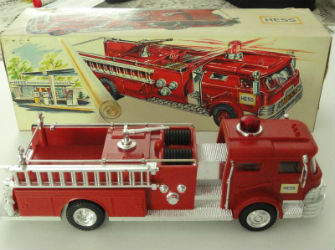
1970 Hess fire truck

1970 Hess fire truck information
1) Historical overview
The 1970 Hess fire truck is a milestone release because it introduced an emergency-response theme to a lineup that had been dominated by fuel transport vehicles. The toy is commonly documented as a replica of a pumper-style fire engine used at a Hess oil refinery in Port Reading, New Jersey, linking the model to real-world company operations.
For collectors researching how the lineup evolved into the 1970s, the best starting point is the year-by-year index:
List of Hess Trucks by Year<.
For broader background on the tradition itself, see
When Did the Hess Trucks Start?<
and
Hess Truck History and Leon Hess<.
2) Features and play functions
The 1970 fire truck includes multiple hands-on features that are helpful for both identification and documentation.
- Rotating emergency light: A working warning light on the cab roof designed to rotate when activated.
- Swiveling water cannon: A roof-mounted cannon that turns to simulate firefighting action.
- Detachable accessories: Two removable rubber hoses on one side and a detachable ladder on the other.
- Rolling action: Free-rolling wheels for tabletop play or display repositioning.
3) Design and construction
Collectors often note the 1970 model for its distinctive finish and detailing compared with earlier releases.
- Bright red body: A fire-engine color scheme that stands out from the green-and-white Hess presentation used on many earlier toys.
- Chrome detailing: The first release in the fleet commonly noted for bright chrome wheels and hubcaps.
- Chrome undercarriage: The underside of the truck is finished in chrome for additional visual impact.
- Accessory mounting points: Hose and ladder attachment areas are useful checkpoints when documenting completeness.
4) Collectibility considerations
Collector documentation for 1970 typically focuses on completeness, originality, and the condition of functional parts.
- Completeness: Confirm hoses and ladder are present and store them separately to prevent loss.
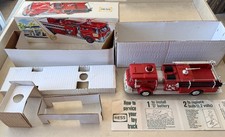
- Lighting function and battery area: Photograph the battery compartment; check for corrosion even if you do not test the light.
- Chrome wear: Note scuffs or dulling on wheels, hubcaps, and the underside finish.
- Reference materials: See
Hess Truck Books / Price Guide<
for common reference sources used by collectors.
1970 Hess fire truck – examples for sale
Listings can be useful for comparing condition, completeness (hoses/ladder), and presentation. Use the identification points above while browsing.

5) Collector tips
- Photograph everything first: Include close-ups of the hoses, ladder, chrome wheels, and the underside.
- Remove batteries for storage: Prevent leakage damage, especially around the battery compartment.
- Protect chrome: Avoid abrasive cleaners that can scratch chrome-finished surfaces.
- Store in stable conditions: Keep away from heat, humidity, and direct sun; see
How to Store Your Hess Trucks.
6) Optional FAQ
What makes the 1970 Hess fire truck distinctive in the lineup?
It is commonly documented as the first Hess release to feature a fire engine theme, with detachable hoses and ladder, a swiveling water cannon, and a working rotating emergency light. Collectors also note its bright chrome wheels, hubcaps, and chrome-finished underside.
Where can I confirm battery information for Hess trucks?
Battery requirements vary by model. The battery compartment itself is the best confirmation point, and many collectors also reference the
Hess Battery Chart<.