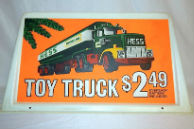
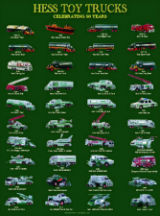
Hess Trucks:
1969 Hess Amerada tanker truck

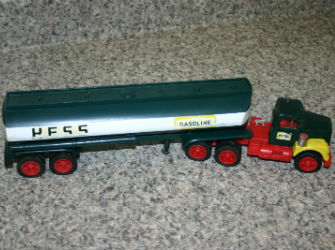
1969 Hess Amerada tanker truck information
Historical overview
The 1969 Hess Amerada tanker truck continues the classic tanker theme that defined the early Hess Toy Truck tradition. Collectors frequently study 1969 alongside nearby tanker releases to document subtle differences in packaging, markings, and condition patterns.
For structured context within this era, start with the decade hub:
Hess Truck Checklist: 1960s,
then compare directly with
1968 Hess Amerada tanker truck.
Collector note often documented for boxed examples: the tanker returned in both 1968 and 1969 with a standard white protective packing base. The commonly noted box difference is on the back panel—where “Woodbridge, N.J.” replaced “Perth Amboy” on the later version.
For broader series background, see:
When Did the Hess Trucks Start?
and
Hess Truck History and Leon Hess.
Features and play functions
The 1969 tanker was designed as a working-style toy with practical play functions that also serve as useful identifiers during research.
- Lighting function: Battery-powered lights controlled by a switch on the toy.
- Rolling action: A sturdy chassis with free-rolling wheels.
- Tanker play details: A hose/fill-style feature commonly associated with early tanker play.
Design and construction
The truck uses a classic tractor-and-tanker trailer configuration. Collectors typically document markings first, then check high-wear areas and the battery compartment.
- Branding and markings: Photograph logos/lettering for consistent year-to-year comparison.
- Trailer feet: Square trailer feet are commonly associated with late-1960s tanker models.
- Battery compartment: Check for corrosion or residue; document with photos.
- Packaging: When present, record box construction and wording details (especially the back panel location text).
For photo documentation ideas across the lineup, use:
Hess Truck Picture Guide.
Collectibility considerations
Collectors generally evaluate 1969 by originality, completeness, and documentation—especially because it is closely related to adjacent years.
- Condition: Check decals, paint, and common wear points.
- Completeness: Document accessories and store small parts separately.
- Battery area: Photograph compartment condition for records.
- References: See
Hess Truck Books / Price Guide.
For a general collector reference page used across many years, see:
Hess Truck Value / Collector Reference.
1969 Hess Amerada tanker truck – examples for sale
Collectors often compare multiple listings to observe differences in condition, completeness, and packaging presentation. Use the details above to verify model-year features while browsing.

Collector tips
- Photograph before cleaning: Capture all sides, underside, close-ups of markings, and the battery area.
- Remove old batteries: Prevent leakage-related damage during storage.
- Store accessories separately: Loose parts can rub paint/decals in storage.
- Use gentle cleaning: Avoid harsh cleaners that may lift decals or cloud plastic parts.
- Storage practices: Keep in a stable, dry environment away from direct sunlight; see
How to Store Your Hess Trucks.
Optional FAQ
What is the most commonly noted box difference between 1968 and 1969?
Collectors often document the back-of-box location wording, where “Woodbridge, N.J.” replaced “Perth Amboy” on the later version. Comparing boxed examples alongside
1968
can be helpful.
Where can I confirm battery information for Hess trucks?
Battery sizes can vary by model, so it’s best to confirm using the battery compartment and a reference:
Hess Battery Chart
and
Hess Pre-Installed Batteries.
Other Hess truck from the 1960's
Hess Trucks: 1968 Hess Amerada tanker truck
Hess Trucks: 1969 Hess Amerada tanker truck