Hess Trucks:
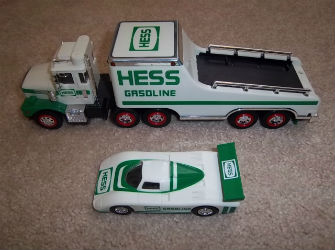
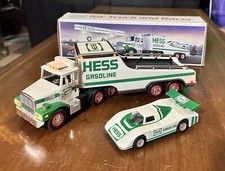
1988 Hess toy truck and racer
1988 Hess toy truck and racer information
1) Historical overview
The 1988 Hess toy truck and racer is a landmark release because it introduced multiple long-running identifiers that collectors still rely on today. It was the first year the holiday set clearly presented two toys in one package (a tractor-trailer style carrier plus a separate vehicle), and it helped establish the practice of using year-marked license plates as a quick visual confirmation of the release year.
For broader context within the decade, use the checklist hub:
Hess Truck Checklist: 1980s.
You can also compare adjacent years for design continuity and packaging differences:
1987 Hess 18 wheeler bank truck
and
1989 Hess toy fire truck bank.
2) Features and play functions
This set is remembered for combining display-friendly details with hands-on play. The truck includes working lights, and the companion racer is designed for simple, repeatable play action.
- Two-piece set: A primary truck plus a separate racing-style car, packaged as a matched pair.
- Working lights: The truck includes operating lights (headlights/taillights), a common feature collectors test and document.
- Friction-powered racer: The GT-styled racing car uses a friction motor for push-and-go play.
- Year identification plates: The year is displayed on license plates, making quick year verification easier during sorting and cataloging.
3) Design and construction
From a collector documentation standpoint, the 1988 release is best recorded as a paired set: the truck (carrier) and the racer (companion vehicle). Collectors often focus on intact markings, clean light lenses, and wear patterns on the tires and edges from handling.
- Truck body and markings: Photograph both sides, the rear, and the underside for reference.
- Light lenses and switches: Check for cracks, clouding, or looseness around the light areas and switch locations.
- Racer details: Document the racer’s body condition and confirm it rolls smoothly under light pressure.
- License plates: Capture close-up photos of the year plates on both the truck and the racer for identification records.
For photo angles and catalog consistency across your collection, use:
Hess Truck Picture Guide.
4) Collectibility considerations
Collectors typically evaluate this release as a complete set with both vehicles present, working or untested lighting documented, and clean identification details (especially the license plates).
- Completeness: Confirm both the truck and racer are included and match the set.
- Lighting condition: Document battery compartment condition and any corrosion before testing.
- Original appearance: Note scuffs along edges and wheel wear from play.
- Reference support: Compare documentation methods and collector terminology using:
Hess Truck Books / Price Guide
and the evergreen collector reference:
Hess Truck Value / Collector Reference.
1988 Hess toy truck and racer – examples for sale
Use the identifiers above (two-piece set, year license plates, and the racer’s friction drive) to compare listings consistently. Condition and completeness can vary widely, so photographs and clear feature confirmation matter.

6) Collector tips
- Photograph the pair together and separately: Include close-ups of the license plates on both vehicles.
- Check the battery area first: If you test lights, document the compartment condition before inserting batteries.
- Store as a matched set: Keep the racer with the truck to avoid mix-ups with other “truck + vehicle” years.
- Use stable storage: Avoid heat and direct sunlight; see
How to Store Your Hess Trucks.
7) Optional FAQ
Why is the 1988 Hess set considered a turning point?
It helped establish two collector-friendly traditions: a two-toy holiday set (truck plus companion vehicle) and year-marked license plates that make identification faster.
Where can I confirm battery-related details across different Hess years?
Use:
Hess Battery Chart
and
Hess Pre-Installed Batteries.
Other Hess trucks from the 1980s